

Views: 2
Aircraft Photography: Giants of the Sky
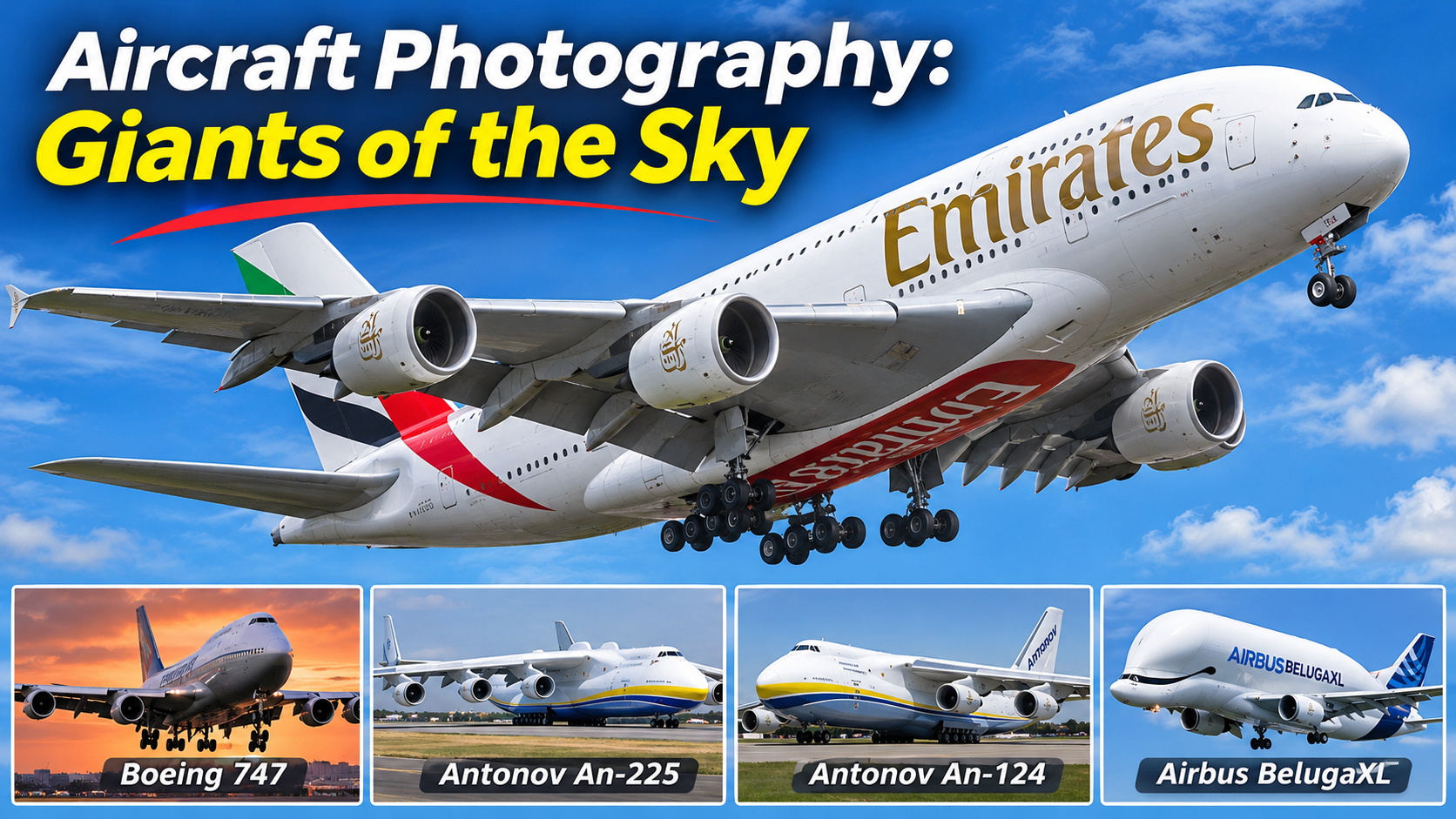
Aircraft photography captures the breathtaking scale, engineering, and beauty of the world’s largest flying machines. From double-deck passenger jets to enormous cargo aircraft, these giants of the sky demonstrate what human innovation can achieve.
In this aviation photography collection, we explore five extraordinary aircraft and the photographic perspectives that reveal their impressive designs.
1. Airbus A380 – The Double-Deck Giant

The Airbus A380 is the world’s largest passenger airliner, featuring two full-length passenger decks, four engines, and an enormous wingspan of approximately 79.8 metres.
Its immense wings and distinctive silhouette make it a spectacular subject for aviation photographers. Photographs taken from below reveal the impressive engineering behind its enormous size.
During takeoff, the aircraft’s landing gear, wing structure, and powerful engines create dramatic compositions that communicate the scale of modern aviation.
2. Boeing 747 – The Queen of the Skies

Few aircraft are as instantly recognizable as the Boeing 747. Famous for its distinctive upper-deck hump and four-engine configuration, the aircraft transformed long-distance air travel.
For photographers, the Boeing 747 offers a combination of elegant design, enormous proportions, and aviation history.
Side-profile photographs emphasize its distinctive fuselage, while dramatic takeoff and landing images demonstrate why the Boeing 747 earned the nickname “Queen of the Skies.”
3. Antonov An-225 Mriya – A Legendary Aircraft

The Antonov An-225 Mriya was one of the most extraordinary aircraft ever built. Developed to transport the Soviet Buran space shuttle, this giant cargo aircraft featured six jet engines, an 88.4-metre wingspan, and an 84-metre-long fuselage.
Its enormous structure made it a favorite among aviation photographers worldwide. Images of the An-225 beside ordinary airport equipment revealed the remarkable difference in scale.
Sadly, the only completed An-225 was destroyed during fighting at Hostomel Airport in Ukraine in February 2022.
Today, historic photographs preserve the appearance and legacy of this remarkable aircraft.
4. Antonov An-124 Ruslan – The Heavy-Lift Workhorse

The Antonov An-124 Ruslan is among the largest cargo aircraft ever to enter regular service. Designed to carry exceptionally heavy and oversized freight, it features a massive fuselage, high-mounted wings, and four powerful jet engines.
Photographers can emphasize its extraordinary size by including airport vehicles, people, or nearby aircraft within the composition.
Its complex landing gear and enormous cargo-loading structure also provide fascinating opportunities for close-up photography.
5. Airbus BelugaXL – The Flying Whale

The Airbus BelugaXL is one of aviation’s most unusual aircraft. Its oversized, rounded fuselage resembles a beluga whale and is designed to transport large aircraft components between Airbus production facilities.
Unlike conventional passenger aircraft, the BelugaXL has a highly distinctive upper fuselage that makes it immediately recognizable.
Photographers can best capture its remarkable appearance from the side, where the enormous cargo compartment and unusual silhouette are clearly visible.
6. The Art of Photographing Giant Aircraft
Photographing enormous aircraft requires more than simply pointing a camera at the sky. Composition, lighting, perspective, and timing all contribute to a memorable aviation photograph.
Low-Angle Photography
Low-angle perspectives emphasize the extraordinary scale of aircraft wings, engines, and landing gear. They are especially effective during takeoff and landing.
Golden-Hour Photography
Early morning and late afternoon sunlight creates warm highlights and dramatic shadows. Large aircraft can produce beautiful silhouettes against colorful skies.
Scale and Perspective
Including nearby airport buildings, service vehicles, or other aircraft helps viewers understand the impressive dimensions of giant airplanes.
Action Photography
Photographing aircraft during takeoff, landing, or banking turns creates dynamic images that communicate movement, speed, and power.
7. Essential Aircraft Photography Tips
- Use a telephoto lens: A 100–400 mm zoom is useful for capturing aircraft at a distance.
- Choose a fast shutter speed: Around 1/1000 second or faster helps freeze moving jet aircraft.
- Focus on composition: Leave space in the direction of flight to create a sense of movement.
- Watch the weather: Clouds, blue skies, and atmospheric conditions can add visual drama.
- Photograph the details: Engines, winglets, landing gear, and cockpit windows can be compelling subjects.
- Choose safe locations: Follow airport security regulations and photograph only from authorized areas.
- Experiment with angles: Side profiles, head-on views, and upward perspectives each reveal different aspects of aircraft design.
8. Why Giant Aircraft Make Extraordinary Photography Subjects
Large aircraft combine technological complexity with impressive visual design. Their enormous wings, powerful engines, distinctive shapes, and remarkable capabilities create countless photographic possibilities.
Beyond their physical dimensions, these flying machines represent important chapters in aviation history. Some transformed passenger travel, while others made it possible to transport cargo that could not realistically be moved by smaller aircraft.
Aircraft photography celebrates these achievements by preserving moments of flight, engineering, and human ambition.
Conclusion
From the majestic Airbus A380 and iconic Boeing 747 to the legendary Antonov An-225, powerful An-124, and uniquely shaped BelugaXL, giant aircraft offer extraordinary subjects for photography.
Every photograph tells a story of innovation, scale, and the remarkable ability of these machines to take to the skies.
Whether photographed on an airport runway or soaring through the clouds, the giants of aviation continue to inspire photographers and enthusiasts around the world.
Photography Credits and Licenses
All photographs are sourced from Wikimedia Commons. Please retain the credits and respect the individual Creative Commons license terms.


