
Views: 0
Desert Wildlife: Animals of the Arabian Peninsula
The Arabian Peninsula is home to an extraordinary collection of desert animals. Despite scorching temperatures, scarce rainfall, and vast expanses of sand, wildlife has developed remarkable adaptations to survive in one of the world’s harshest environments.
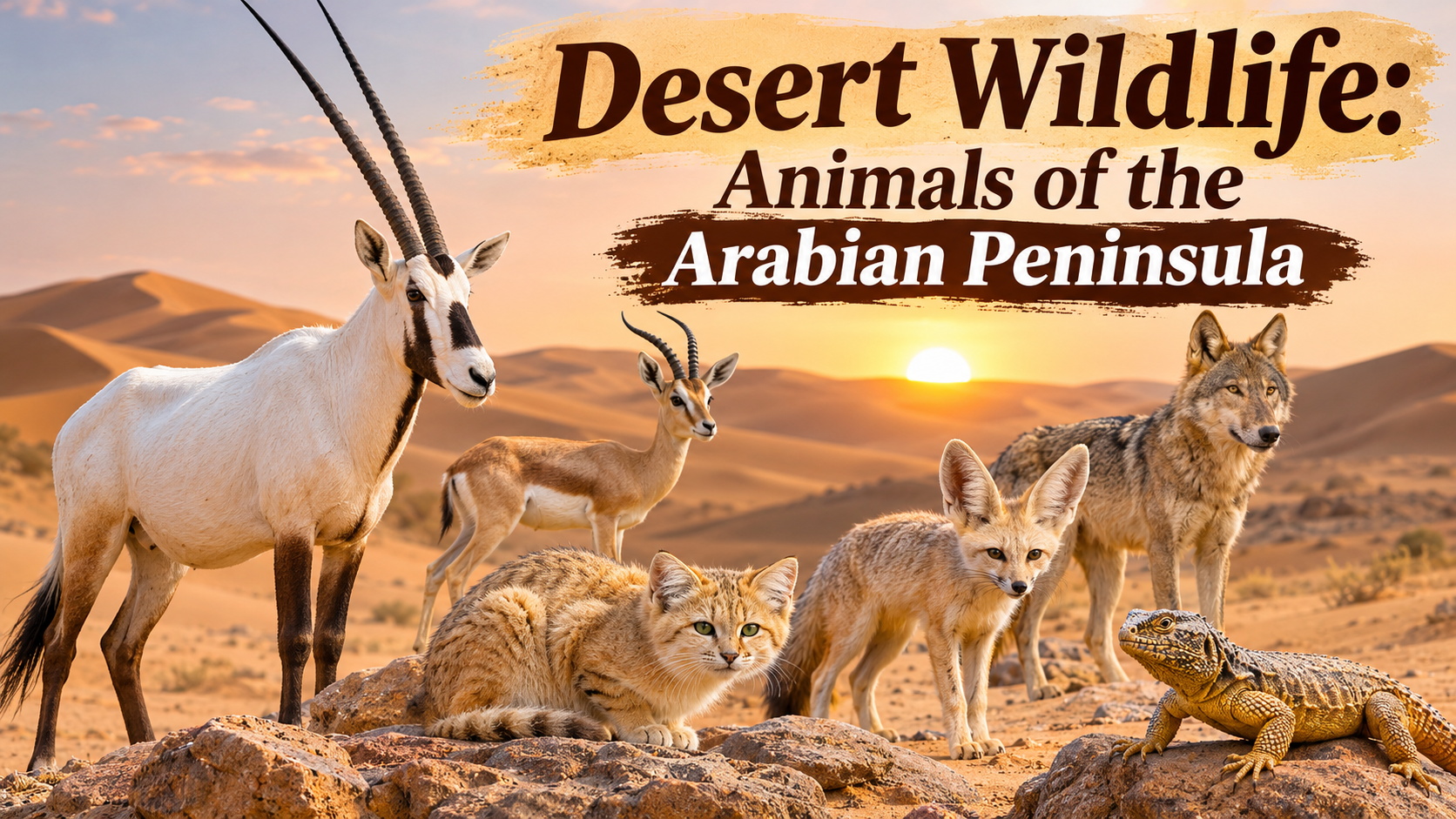
From the elegant Arabian oryx and swift sand gazelle to the elusive sand cat, Arabian wolf, and desert reptiles, each species plays an important role in maintaining ecological balance.

The Arabian Peninsula: A Unique Desert Ecosystem
The Arabian Peninsula includes the United Arab Emirates, Saudi Arabia, Oman, Yemen, Qatar, Bahrain, and Kuwait. Its landscapes feature enormous sand dunes, gravel plains, rocky mountains, dry valleys, and coastal habitats.
One of its most famous landscapes is the Rub’ al Khali, commonly known as the Empty Quarter, one of the world’s largest continuous sand deserts.
Although desert landscapes may appear lifeless, numerous mammals, birds, reptiles, and invertebrates have evolved ways to survive with limited water and vegetation.
1. Arabian Oryx: The Icon of Desert Conservation
Scientific name: Oryx leucoryx
The Arabian oryx is one of the most recognizable animals of the Arabian Peninsula. This beautiful antelope has a bright white coat, dark facial markings, and long, straight horns.
Its pale coloration reflects sunlight, helping reduce heat absorption. Arabian oryx can travel substantial distances searching for vegetation and moisture.
Perhaps its greatest distinction is its conservation history. The species became extinct in the wild in the early 1970s but was later reintroduced through coordinated captive-breeding and wildlife protection programs.
Today, protected areas in the UAE, Saudi Arabia, Oman, and other countries support Arabian oryx conservation.
2. Arabian Sand Gazelle: Grace and Speed
Scientific name: Gazella marica

Known locally as Al Reem, the Arabian sand gazelle is a graceful animal perfectly adapted to open desert landscapes.
Its slender legs allow it to move quickly across desert terrain, while its sandy-colored coat provides camouflage against predators.
These gazelles feed on grasses, shrubs, and other desert vegetation. They can obtain much of their water from plants when suitable food is available.
Hunting, habitat loss, and human disturbance have affected wild gazelle populations. Conservation programs and protected areas remain important for their future.
3. Sand Cat: The Secretive Desert Hunter
Scientific name: Felis margarita

The sand cat is one of the desert’s most fascinating and elusive predators. This small wild feline is specially adapted to sandy, arid environments.
Unlike domestic cats, sand cats have dense fur covering the soles of their feet. This helps insulate their paws against extreme ground temperatures and provides protection while moving across sand.
Large ears and excellent hearing enable sand cats to detect rodents and other prey, including animals moving beneath the sand.
Sand cats are primarily nocturnal. They spend much of the day resting in burrows and emerge after sunset to hunt small mammals, birds, insects, and reptiles.
They can survive for extended periods without drinking free-standing water when their prey provides sufficient moisture.
4. Rüppell’s Fox: A Master of Desert Survival
Scientific name: Vulpes rueppellii

Rüppell’s fox is a small desert-dwelling fox found in parts of the Arabian Peninsula and North Africa.
Its sandy fur helps it blend into the landscape, while its relatively large ears assist with hearing and heat regulation.
This fox is an opportunistic feeder. Its diet may include small mammals, insects, reptiles, and plant material.
To escape the extreme daytime heat, it usually rests in sheltered areas or burrows and becomes more active during cooler nighttime hours.
5. Arabian Wolf: A Rare Desert Predator
Scientific name: Canis lupus arabs

The Arabian wolf is a desert-adapted form of the gray wolf. Generally smaller than many northern wolf populations, it inhabits isolated desert, mountain, and rocky landscapes.
Arabian wolves feed opportunistically on small mammals, birds, and other available food sources. They may also scavenge animal carcasses.
They play an ecological role as predators and scavengers, but face considerable pressure from persecution, habitat disturbance, and conflict with people.
Protecting remaining populations requires habitat conservation, monitoring, and strategies to reduce livestock-related conflicts.
6. Spiny-Tailed Lizard: The Famous Dhub
Scientific name: Uromastyx aegyptia

The spiny-tailed lizard, commonly known as the dhub, is one of the most distinctive reptiles of the Arabian Desert.
It has a powerful body, short legs, and a thick tail covered with protective spikes.
Unlike many carnivorous desert reptiles, adult spiny-tailed lizards primarily consume vegetation, including leaves, flowers, and seeds.
They dig burrows that provide protection from predators and extreme temperatures. These burrows can also offer shelter to other small desert organisms.
The dhub is typically active during daylight and relies on external heat to regulate its body temperature.
How Arabian Desert Animals Survive Extreme Conditions
Life in the desert presents several challenges: intense solar radiation, high temperatures, limited drinking water, and unpredictable food availability.
Nocturnal Behavior
Many desert mammals, including sand cats and foxes, become active after sunset when temperatures are lower.
Water Conservation
Some desert species obtain moisture from plants or prey, reducing their dependence on permanent water sources.
Camouflage
Pale brown, golden, and sandy colors allow animals to blend into desert landscapes, reducing their visibility to predators and prey.
Burrowing
Burrows can provide cooler, more stable environments during the day and protection from predators.
Specialized Feet and Bodies
Broad paws, protective foot coverings, efficient kidneys, and adaptations that limit overheating help desert animals survive difficult conditions.
Why Desert Wildlife Matters
Every desert animal contributes to the functioning of its ecosystem. Predators can influence prey populations, herbivores affect vegetation, and burrowing animals modify soil habitats.
Birds and insects also contribute to ecological functions such as pollination, seed dispersal, and nutrient cycling.
The disappearance of one species may affect others through complex food-web relationships.
Threats to Arabian Desert Wildlife
Despite their remarkable survival abilities, desert animals face several growing challenges.
- Habitat loss: Urban expansion, infrastructure, and land conversion reduce natural habitats.
- Illegal hunting: Some species remain vulnerable to unsustainable hunting and persecution.
- Road traffic: Roads fragment habitats and create collision risks.
- Climate change: Rising temperatures and changing rainfall patterns may alter desert ecosystems.
- Human disturbance: Off-road driving and uncontrolled recreation can damage fragile habitats and animal burrows.
Wildlife Conservation in the Arabian Peninsula
Conservation initiatives across the region aim to protect native species and restore damaged ecosystems.
In the United Arab Emirates, the Dubai Desert Conservation Reserve and protected areas managed by the Environment Agency – Abu Dhabi support important wildlife conservation work.
In Saudi Arabia, wildlife restoration and reintroduction initiatives have focused on native species such as the Arabian oryx and gazelles.
Effective conservation requires scientific monitoring, habitat protection, enforcement against illegal hunting, and public awareness.
Frequently Asked Questions
What is the most famous animal of the Arabian Desert?
The Arabian oryx is among the most iconic animals because of its distinctive appearance and successful reintroduction after becoming extinct in the wild.
Are there wild cats in the Arabian Peninsula?
Yes. Sand cats and Arabian wildcats inhabit parts of the region, while the Arabian leopard survives in extremely limited mountain habitats.
How do desert animals survive without water?
Many species obtain moisture from food, conserve water efficiently, avoid excessive daytime heat, or move in search of suitable resources.
Are Arabian desert animals endangered?
Conservation status varies by species. Some have recovered through protection and reintroduction, while others remain threatened by habitat loss, hunting, and human disturbance.
Conclusion: Protecting Arabia’s Natural Heritage
The Arabian Peninsula’s deserts are far more than endless dunes and rocky plains. They are living ecosystems shaped by millions of years of adaptation.
From the Arabian oryx and sand gazelle to the sand cat, fox, wolf, and spiny-tailed lizard, each animal represents a unique part of Arabia’s natural heritage.
Preserving these species and their habitats is essential for maintaining biodiversity and ensuring that future generations can discover the remarkable wildlife of the Arabian Desert.
Photography Credits and Licenses
The wildlife photographs used in this article are hosted by Wikimedia Commons. Their individual Creative Commons licenses permit reuse subject to the applicable attribution and, where relevant, share-alike requirements. Photographs are presented without intentional modification.
- Arabian oryx — Charles J. Sharp, CC BY-SA 3.0
- Arabian sand gazelle — Charles J. Sharp, CC BY-SA 4.0
- Sand cat — Ranjith-chemmad, CC BY-SA 4.0
- Rüppell’s fox — Jesper Särnesjö, CC BY 2.0
- Arabian wolf — Shankar S., CC BY 2.0
- Spiny-tailed lizard — Aboyahia74, CC BY-SA 4.0
Further Reading
- IUCN Red List of Threatened Species
- Environment Agency – Abu Dhabi
- Dubai Desert Conservation Reserve
Explore more fascinating wildlife stories at Bin3aiah Animals.