


Views: 2
The Art of Black-and-White Street Photography
Capturing Emotion, Contrast, and Timeless Stories
Phil Penman: Street Scenes – gestalten
Grayscale shot of two men walking down an alley casting shadows on the foreground
16
Black-and-white street photography transforms ordinary moments into powerful visual stories. By removing color, photographers invite viewers to focus on light, shadow, texture, composition, and human emotion.
A crowded sidewalk, a quiet alley, or a stranger waiting at a bus stop can become a compelling photograph when captured at the right moment.
Unlike carefully staged portraits or studio photographs, street photography celebrates the beauty of everyday life as it naturally unfolds.
1. Why Black and White Creates Stronger Stories
Color can communicate atmosphere, but it can also distract from a photograph’s essential subject. Black and white simplifies the scene and emphasizes its visual structure.
Three elements become especially important:
- Light and shadow: Strong contrasts create atmosphere, mystery, and visual depth.
- Emotion and expression: Gestures, facial expressions, and interactions often become more noticeable without competing colors.
- Shapes and textures: Architecture, pavement, reflections, clothing, and silhouettes form striking patterns.
A successful monochrome photograph does more than document a location. It captures how a moment feels.
2. Mastering Light and Shadow
Interview with Laurence Bouchard , amazing Street Photographer from UK : Retro Kolkata Exclusive
Phil Penman: Street Scenes – gestalten
Exposed In The Light :: Behance
16
Light is one of the most important tools in black-and-white photography.
Hard sunlight produces defined shadows and dramatic separation between bright and dark areas. Early morning and late afternoon often provide long shadows that enhance composition.
Overcast skies create softer light, ideal for portraits, delicate textures, and scenes with subtle tonal differences.
Nighttime illumination introduces glowing windows, streetlights, headlights, and illuminated signs. These elements can create cinematic photographs with deep blacks and bright highlights.
Try observing how people move through patches of sunlight. Sometimes the best photograph emerges when a person enters a carefully composed area of light.
3. Composition Techniques That Make Images Stand Out
A man walking down a street under a bridge photo – Free Grey Image on Unsplash
Leading lines
Use sidewalks, buildings, railings, and roads to guide the viewer’s eye toward the subject.
Sydney Photographic Workshops | Sydney | ClassBento
Natural framing
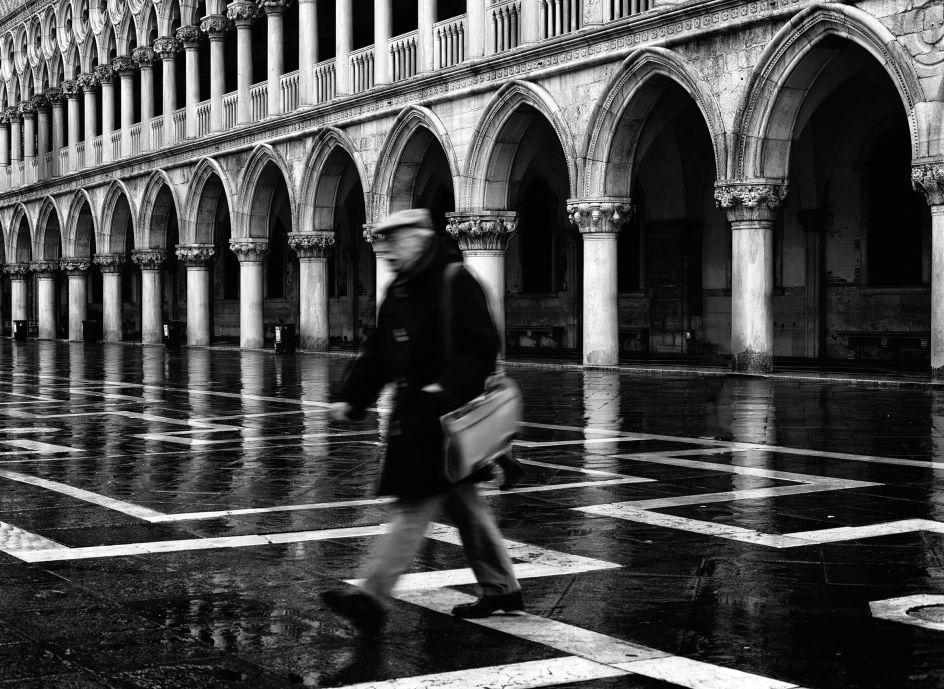
Doorways, arches, windows, and architectural structures help isolate your subject and add visual depth.
The ultimate guide to minimalist photography – 500px
Negative space
Empty walls, open streets, and uncluttered backgrounds can convey solitude, scale, and simplicity.
Reflections and symmetry
Puddles, glass buildings, and polished surfaces can introduce unexpected perspectives and compelling geometry.
4. Camera Settings for Street Photography
There is no universal camera setting for every street scene, but these starting points can help:
| Setting | Recommended starting point |
|---|---|
| Shooting mode | Aperture Priority or Manual |
| Aperture | f/5.6–f/8 |
| Shutter speed | 1/250–1/500 sec for moving people |
| ISO | Auto ISO, adjusted to available light |
| Focal length | 28mm, 35mm, or 50mm |
| File format | RAW for editing flexibility |
| Focus | Continuous autofocus or zone focusing |
A 35mm lens is especially versatile for combining people with their surroundings, while a 50mm lens offers a tighter perspective.
When possible, photograph in RAW and use a monochrome camera preview. This helps you visualize the scene in black and white while preserving editing flexibility.
5. Capturing Genuine Human Moments
Anachronistic — John Harper | Photography
London street photography — JEFF ASCOUGH
The Kodak Snapic A1 is a $99 Film Camera With a Double Exposure Switch | PetaPixel
14
The most memorable street photographs frequently reveal human experiences: joy, loneliness, friendship, movement, contemplation, and curiosity.
Develop patience rather than rushing from one location to another. Look for an interesting background, observe the light, and wait for the right moment to appear.
Pay attention to small gestures and interactions that convey a story without explanation.
Respect personal boundaries, avoid exploiting vulnerable people, and follow local photography and privacy requirements. In the UAE, photographing or publishing identifiable people without appropriate consent can raise legal and privacy concerns.
6. Editing Black-and-White Street Photographs
Post-processing should strengthen the original composition, not overwhelm it.
A practical editing workflow includes:
- Exposure: Establish balanced overall brightness while preserving important detail.
- Contrast: Adjust the difference between bright and dark tones.
- Highlights and shadows: Recover useful detail without flattening the image.
- Black-and-white color mix: Control how original colors translate into shades of gray.
- Dodge and burn: Selectively brighten or darken areas to guide attention.
- Grain and sharpness: Apply subtle adjustments that complement the photograph’s character.
Avoid crushing every shadow into pure black or pushing every highlight to pure white. Tonal richness often matters more than extreme contrast.
7. Inspiration From Legendary Street Photographers
Exploring established photographers can help develop your own visual language.
Henri Cartier-Bresson Henri Cartier-Bresson: The Eye of the Century
Henri Cartier-Bresson
Known for the decisive moment, he emphasized geometry, timing, and spontaneous human movement.
Exhibition on Vivian Maier | METALOCUS
Vivian Maier
Her street photographs documented everyday city life through sharp observation and expressive compositions.
Photographie en Vente aux Enchères en Ligne – Catawiki
Fan Ho
Celebrated for cinematic light, architectural geometry, and atmospheric monochrome scenes in Hong Kong.
8. Five Creative Challenges for Your Next Photo Walk
- Capture one person emerging from a dramatic shadow.
- Find five different reflections in windows or puddles.
- Create a photograph using only silhouettes and shapes.
- Photograph a familiar street from an unusual low viewpoint.
- Tell a complete visual story through a sequence of three photographs.
The goal is not simply to produce more images, but to train your eye to recognize meaningful moments.
Conclusion
Black-and-white street photography is an art of observation, patience, and visual storytelling. It reveals beauty in ordinary situations and turns fleeting moments into lasting memories.
The strongest photographs are not necessarily made with expensive cameras. They are created by photographers who understand light, recognize emotion, and know when to press the shutter.
A great street photograph doesn’t just show what happened. It makes the viewer feel as though they were there.
Photography privacy guidance: UAE Government and Abu Dhabi Judicial Department. U.AE+1
WordPress SEO Package
| Field | Recommended content |
|---|---|
| SEO Title | Black-and-White Street Photography: Complete Guide |
| Slug | black-and-white-street-photography |
| Category | Photography / Street Photography |
| Focus keyword | Black-and-white street photography |
| Secondary keywords | Monochrome photography, street photography tips, urban photography, photography composition |
| Image alt text | Dramatic black-and-white street photograph featuring urban shadows, architecture, and everyday life |
Meta description:
Learn the art of black-and-white street photography with expert tips on lighting, contrast, composition, camera settings, and editing.
WordPress tags:
Black and White Photography, Street Photography, Monochrome Photography, Urban Photography, Fine Art Photography, Photography Tips, Light and Shadow, Street Portraits, Camera Settings, Photo Editing, Documentary Photography, Visual Storytelling, Composition
Suggested featured image: A cinematic monochrome city street with one pedestrian crossing a beam of sunlight, deep architectural shadows, and a strong sense of atmosphere. Use a 16:9 landscape composition.