


Views: 0
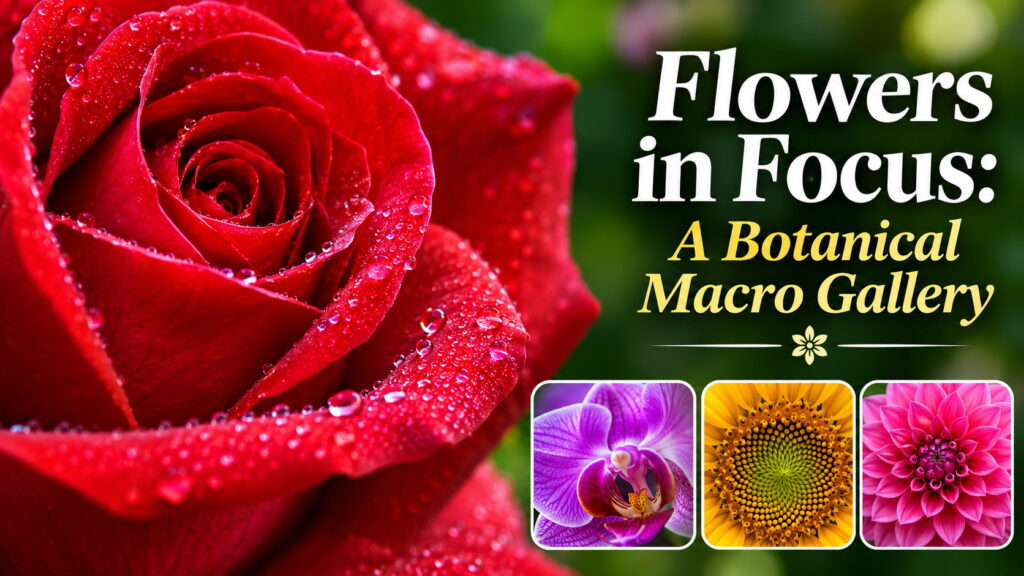
Flowers in Focus: A Botanical Macro Gallery
Flowers are among nature’s most beautiful creations. Yet their true complexity often remains hidden from the naked eye. Through macro photography, delicate petals, colorful pollen, intricate floral structures, and extraordinary natural patterns become visible in stunning detail.
In this botanical photography collection, we explore the miniature world of flowers, celebrating the colors, textures, and fascinating designs that make each bloom unique.


The Hidden Beauty of Flower Macro Photography
Macro photography allows photographers to capture small subjects at close range, revealing details that are difficult to appreciate at normal viewing distances.
When photographed closely, rose petals resemble flowing silk, orchid blossoms reveal complex floral structures, and the center of a sunflower transforms into an intricate arrangement of spirals.
Light, perspective, and selective focus can turn even the smallest flower into a remarkable photographic subject.
Botanical Macro Gallery: Ten Flowers in Focus


1. Rose — Delicate Layers
The rose is a classic symbol of floral elegance. Its overlapping petals form graceful curves and subtle variations in color. Macro photography highlights the fine textures, delicate edges, and intricate folds of each petal.


2. Orchid — Floral Architecture
Orchids are famous for their extraordinary variety of shapes and colors. Many species feature a specialized petal known as the lip, which helps interact with pollinators. Close-up photography reveals their complex and beautiful structures.


3. Dahlia — Natural Geometry
Dahlias display some of the most striking patterns in the floral world. Their flower heads can contain numerous densely arranged florets, creating captivating patterns of symmetry, repetition, and color.


4. Hibiscus — A World of Pollen
The hibiscus attracts attention with its colorful petals and prominent reproductive structures. Its pollen-producing anthers and distinctive stigma offer fascinating subjects for detailed macro images.


5. Sunflower — Spirals of Nature
A sunflower head contains numerous individual florets. The small florets in the center form striking spiral arrangements, often associated with Fibonacci-like patterns found throughout the natural world.


6. Lavender — Tiny Purple Blossoms
Lavender is known for its distinctive fragrance and beautiful purple flower clusters. A close-up view reveals small individual blossoms that are easily overlooked when admiring the plant from a distance.


7. Hydrangea — Clusters of Color
Hydrangeas produce beautiful clusters of flowers that may appear pink, blue, purple, or white. In some species and cultivars, flower color is influenced by soil chemistry, especially the availability of aluminum.


8. Marigold — Golden Textures
Marigolds brighten gardens with brilliant yellow and orange tones. Their densely arranged petals or florets provide wonderful opportunities to study texture, color gradients, and the interplay of light and shadow.


9. Lily — Elegant Floral Details
Lilies have large, expressive flowers with prominent stamens. Their colorful anthers and textured petals make them especially appealing for photographs that focus on the smaller details of floral anatomy.


10. Floral Petals — Abstract Beauty
At high magnification, petals become abstract compositions of shapes and colors. Smooth transitions, fine surface details, and delicate curves create images that combine botanical observation with art.
The Science Hidden Inside Every Flower
Flowers are not simply decorative structures. Many play essential roles in plant reproduction, supporting interactions between flowering plants and pollinating animals.
The stamens contain pollen-producing anthers, while the pistil or carpel includes structures such as the stigma, style, and ovary. During pollination, pollen is transferred to a compatible stigma.


Some flowers also contain visual patterns that help guide pollinating insects toward nectar and pollen. Certain patterns are visible primarily in ultraviolet wavelengths, which humans cannot see without specialized imaging.
These fascinating adaptations demonstrate that floral beauty is closely connected with biological function.
How to Photograph Flowers in Macro
Creating compelling flower macro photographs does not always require expensive equipment. Good lighting, careful composition, and patience can make a tremendous difference.
- Choose soft natural light: Early morning and cloudy conditions produce gentle shadows and preserve delicate details.
- Focus on one feature: Select a petal edge, anther, droplet, or repeating floral pattern as the main subject.
- Control depth of field: Wider apertures can create beautifully blurred backgrounds, while smaller apertures reveal more of the subject in focus.
- Stabilize the camera: A tripod or stable support can reduce camera movement at close focusing distances.
- Experiment with perspective: Photograph from above, below, or from the side to discover unexpected compositions.
- Look for fine textures: Pollen, veins, droplets, and petal surfaces can become fascinating photographic subjects.
Flowers as Natural Works of Art
One of the greatest attractions of botanical macro photography is its ability to transform familiar subjects into extraordinary visual experiences.
A rose can resemble an abstract sculpture. A dahlia can appear as an intricate geometric design. A sunflower reveals a miniature world of repeating spirals, while an orchid demonstrates the remarkable diversity of floral forms.
Each photograph reveals how nature combines structure, color, and function in ways that continue to fascinate artists, photographers, and scientists.
Conclusion: Discovering Beauty in the Smallest Details
Flowers remind us that remarkable beauty often exists in the smallest details. Through macro photography, familiar blossoms become captivating subjects filled with texture, color, symmetry, and biological complexity.
From delicate rose petals and intricate orchids to golden sunflower spirals and vibrant marigolds, this botanical gallery encourages us to look more closely at the extraordinary natural world around us.
Explore more nature, wildlife, and photography collections at Bin3aiah Gallery .