


Views: 0
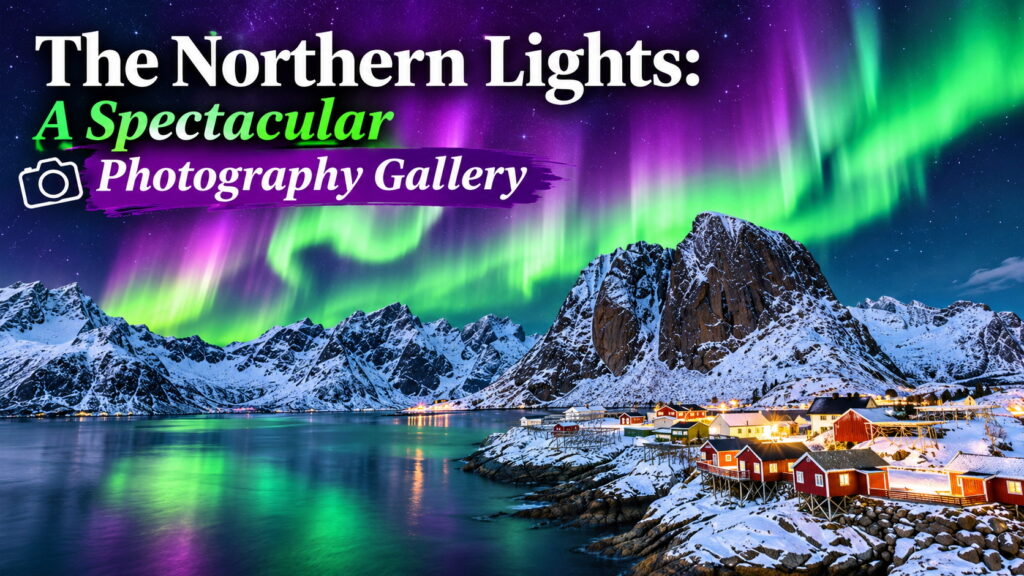
The Northern Lights: A Spectacular Photography Gallery
The Northern Lights, scientifically known as the Aurora Borealis, are among Earth’s most extraordinary natural spectacles. Glowing curtains of green, pink, red, and purple transform the darkness into a constantly changing display of light.
From Norway’s dramatic fjords and Iceland’s volcanic landscapes to the Arctic wilderness, aurora photography reveals the breathtaking beauty of our planet after sunset.
Explore ten remarkable photographs of the Northern Lights and discover the science, landscapes, and photographic techniques behind this natural phenomenon.
1. Northern Lights Above Lofoten, Norway


The Lofoten Islands provide one of the world’s most spectacular settings for aurora photography. Steep mountains rise from the sea, creating dramatic silhouettes beneath the glowing Arctic sky.
When the Northern Lights stretch across this landscape, the combination of rugged scenery and moving light creates extraordinary photographic opportunities.
2. The Aurora Above Lake Mývatn, Iceland


Iceland’s Lake Mývatn region is renowned for its volcanic formations, wide horizons, and opportunities to observe the Northern Lights.
The surrounding landscapes provide striking foregrounds for long-exposure photography. During clear nights, luminous auroral structures can dominate the sky above the lake.
3. A Spectacular Display Over Senja


Senja, Norway’s second-largest island, is a remarkable destination for wilderness and landscape photography.
On active aurora nights, the sky can fill with sweeping bands of light. The constantly evolving shapes make every photograph unique.
4. Moonlight, Stars, and the Icelandic Aurora

Not every aurora appears under completely dark skies. Moonlight can illuminate the landscape and reveal additional details in the foreground.
Photographers often balance exposure carefully to preserve both the colorful aurora and the stars surrounding it.
5. Extraordinary Magenta Northern Lights


Although green is the most familiar aurora color, some displays feature dramatic shades of pink, violet, and magenta.
The colors result from different atmospheric emissions and the conditions under which charged particles interact with Earth’s atmosphere.
During powerful geomagnetic storms, colorful auroras can also become visible much farther south than usual.
6. A Cozy Cabin Beneath the Aurora

Human-made structures can provide a valuable sense of scale in Northern Lights photography.
A small cabin surrounded by darkness helps the viewer appreciate the immense dimensions of the sky. Warm architectural details also contrast beautifully with the cool colors of the aurora.
7. The Northern Lights Over Trysil

Northern Lights displays are constantly changing. A faint band on the horizon may gradually develop into luminous rays or broad curtains of light.
Photographers must adapt quickly as the intensity, position, and movement of the aurora change throughout the night.
8. Aurora and the Perseid Meteor Shower


Occasionally, two remarkable astronomical phenomena share the same sky.
The Perseid meteor shower occurs annually in August, while auroras are influenced by solar and geomagnetic activity. When both occur together, photographers have an opportunity to record an exceptional night-sky scene.
9. Aurora Over Bergen, Norway


Although Bergen lies south of Norway’s most popular Arctic viewing locations, the Northern Lights can sometimes be photographed there during favorable geomagnetic conditions.
Wide panoramic compositions emphasize the enormous scale of auroral formations stretching across the horizon.
10. A Panoramic Aurora Across Iceland


Wide-angle photography is especially effective when the aurora spreads across a large portion of the sky.
Panoramic photographs help communicate the scale of a display, revealing multiple glowing arcs and extensive patterns that may be difficult to capture in a conventional frame.
What Causes the Northern Lights?
The Northern Lights begin with energetic particles from the Sun. Solar activity can disturb Earth’s magnetic environment, accelerating charged particles that interact with gases in the upper atmosphere.
These interactions excite atmospheric atoms and molecules. As they release energy, visible light is produced.
Why Are the Northern Lights Different Colors?
- Green: Commonly produced by atomic oxygen at altitudes around 100–150 kilometers.
- Red: Often associated with oxygen emissions at higher altitudes.
- Blue: Produced by emissions involving molecular nitrogen.
- Purple and pink: Can appear when multiple emissions and colors combine.
The aurora’s appearance depends on atmospheric composition, particle energy, altitude, and geomagnetic conditions.
How to Photograph the Northern Lights
Capturing beautiful aurora photographs requires a combination of suitable equipment, careful camera settings, and favorable weather.
Recommended Camera Settings
| Setting | Suggested Starting Point |
|---|---|
| Lens | Wide-angle, approximately 14–24 mm |
| Aperture | f/1.4 to f/2.8 |
| Shutter Speed | 2–10 seconds |
| ISO | 800–3200 |
| Focus | Manual focus on distant stars |
| File Format | RAW |
| Support | Stable tripod |
Fast-moving auroras benefit from shorter shutter speeds that preserve individual rays. Fainter displays may require longer exposures to reveal their details.
Including mountains, lakes, trees, cabins, or silhouettes can make aurora images more visually compelling.
Best Places to Photograph the Northern Lights
Several northern destinations offer excellent opportunities for aurora observation:
- Tromsø, Norway: Arctic landscapes and accessible aurora-viewing locations.
- Lofoten Islands, Norway: Dramatic coastal mountains and fjords.
- Abisko, Sweden: A well-known location for Arctic sky observation.
- Finnish Lapland: Snow-covered forests and winter scenery.
- Iceland: Volcanic landscapes, waterfalls, and remote dark-sky locations.
- Fairbanks, Alaska: High-latitude aurora-viewing opportunities.
- Yellowknife, Canada: A popular destination for Northern Lights photography.
When Is the Best Time to See the Aurora?
The Northern Lights occur throughout the year, but they are easier to observe when skies are dark.
In many popular Arctic destinations, September through March provides extended nighttime darkness and good opportunities for aurora viewing.
Clear skies, limited artificial light, and favorable geomagnetic conditions significantly improve the chances of seeing a display.
However, no particular night can guarantee an aurora sighting.
Conclusion: Nature’s Extraordinary Light Show
The Northern Lights are among the most beautiful natural phenomena visible from Earth.
From delicate green arcs to spectacular purple curtains, every aurora creates a different visual experience.
For photographers, they offer an extraordinary combination of atmospheric science, landscape beauty, and creative possibility.
Whether photographed above a peaceful Arctic village, a frozen landscape, or a vast mountain range, the Aurora Borealis remains one of nature’s most unforgettable spectacles.
Explore more nature photography galleries and extraordinary natural wonders on Bin3aiah Gallery.
Photography credits and licensing information are provided beneath each image. Images are sourced from Wikimedia Commons. Where cropping, modification, or redistribution occurs, applicable Creative Commons license conditions must be followed.